
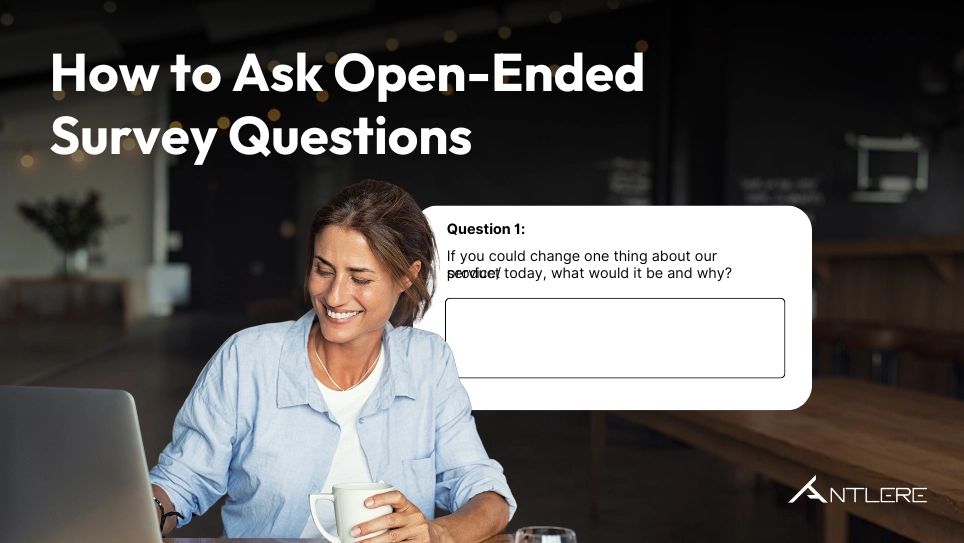
When designing a survey or conducting market research, the choice between question types is paramount to the data’s quality. While simple closed-ended questions provide quantitative data, telling you what happened, it’s the open ended survey questions that provide the qualitative data, explaining why it happened.
These questions require respondents to answer in their own words, giving researchers valuable, in depth context that a simple multiple choice selection can never provide. Understanding when and how to deploy these rich, free form questions is key to gaining actionable business insights.
How do open ended survey questions compare to open and closed ended question examples?
The core difference between open and closed-ended question examples lies in their intended output and analytical value. Closed questions (like ‘Yes/No,’ multiple-choice, or rating scales) yield quick, easy-to-analyze data that allows for straightforward numerical reporting.
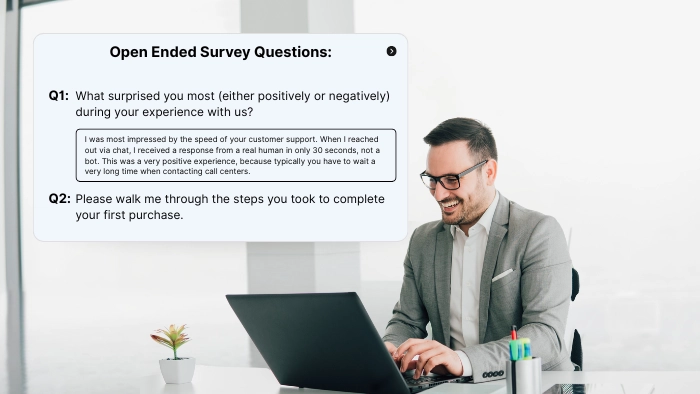
In contrast, open ended survey questions are the foundation of qualitative research, gathering rich, contextual information such as: “What features do you like most about this product, and why?” Using the right mix is critical; closed questions deliver scale and speed, while open questions deliver depth and explanatory context.
How do these questions enhance customer feedback and uncover surprising insights?
The strategic ability of open ended survey questions to gather comprehensive customer feedback is their greatest strength. By allowing customers to voice their opinions freely, these questions often reveal unexpected results or previously unconsidered market gaps that fixed response surveys would miss.
For example, asking “How could we improve our service?” might reveal a widespread need for a new feature or policy change that wasn’t on the development roadmap. This level of authentic, personalized customer feedback helps build stronger relationships with the audience and provides a richer context for subsequent quantitative studies.
What common pitfalls should you avoid when writing effective open ended survey questions?
To maximize the quality of information of qualitative research, the researcher should not fall into the traps that cause biased or unproductive responses. Open ended survey questions must always be open ended (not vague as in “Tell us about your experience) as well as not leading (Not you agree the product is great?).
The best practices are the use of clarifying language (How, why, Explain) and making sure that the question considers a single topic to avoid the possibility of receiving a “double-barreled” response. Also, the restricted access to open questions in general makes it possible to avoid survey fatigue and causes the respondents to spend the required amount of thinking on every particular answer.
What steps can you take to effectively analyze qualitative research data from open-ended responses?
The unstructured text obtained with the help of open ended survey questions can be difficult to analyze, yet the current methods can make it possible. First, the responses should be gathered and organized, which may require an export into a clean format. Then, scholars may use sophisticated text analytics, a kind of automated coding, which in most cases is AI-based to systematically label, theme, and mark responses.

This involves sentiment analysis (establishing whether a reply is either positive, negative, or neutral). When these trends are visualized, pure customer feedback can be used to obtain valuable insights that can be used to make actionable decisions due to such qualitative research.
Conclusion: How can a focus on qualitative research propel your business forward?
Ultimately, incorporating open ended survey questions into your data collection strategy is a powerful way to move beyond simple statistics and truly understand the voice of your customer. By prioritizing qualitative research and ensuring you capture detailed, free-form customer feedback, your organization gains the context needed for meaningful innovation and targeted improvements.
Don’t just count the responses, analyze the reasons behind them, and use that rich data to propel your product, service, and strategic planning forward.